 Asset Vault
Guide
Collector car documentation checklist: every record a buyer wants
This is the working checklist behind the Asset Vault system — the complete contents of a collector car’s record file, in the order buyers, auction houses and insurers evaluate it. Work it top to bottom when you buy a car, and keep it current while you own it.
Published October 2026 · Asset Vault guides are maintained as the platforms and insurers change their expectations.
Why this order, and why completeness matters: a buyer works through a car the way an underwriter works through a claim — identity first, then history, then proof. Each section below answers the question the previous one raises. And gaps are priced, not forgiven. The Vehicle Remarketing Association calls absent service history the number one factor that unnecessarily reduces a car’s value when it sells — an impact easily running to 5% or more, with around a quarter of auction vehicles presented with no service history at all. On a high-value car, that is a five-figure discount for a folder’s worth of paper. Every section of this checklist closes one part of that gap.
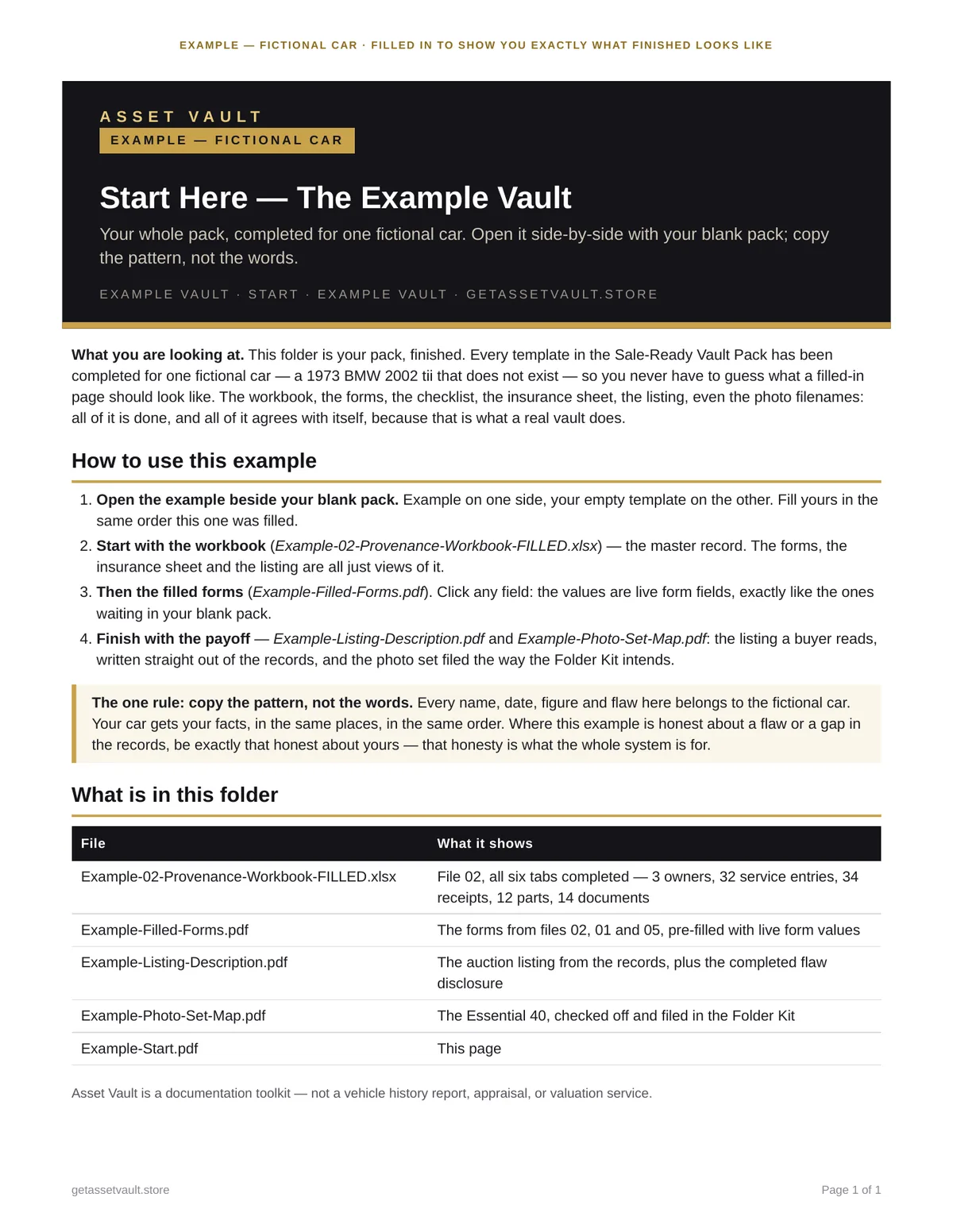
For each part of the file: what belongs in it, where those documents usually live today, what buyers and insurers actually check, and — so “complete” is something you can see — how the finished section looks in our worked Example Vault, the system completed end to end for a fictional 1973 BMW 2002 tii.
1. Identity & build data
- VIN plate photo + VIN decode (year, model, trim, assembly plant)
- Build sheet, window sticker, or manufacturer heritage certificate where available
- Engine, transmission and axle numbers — and matching-numbers status where the marque tracks it
- Paint and trim codes; current color vs. factory color, honestly noted
- Original options list; factory documentation (manuals, warranty booklet, tool kit, spare)
Where it lives today: the VIN is on the car; everything else is wherever the last three owners left it — a window sticker in a frame, a build sheet under the rear seat (where several manufacturers genuinely hid them), a heritage certificate nobody ordered. Ordering the certificate and photographing every data plate is an afternoon’s work that most sellers never do.
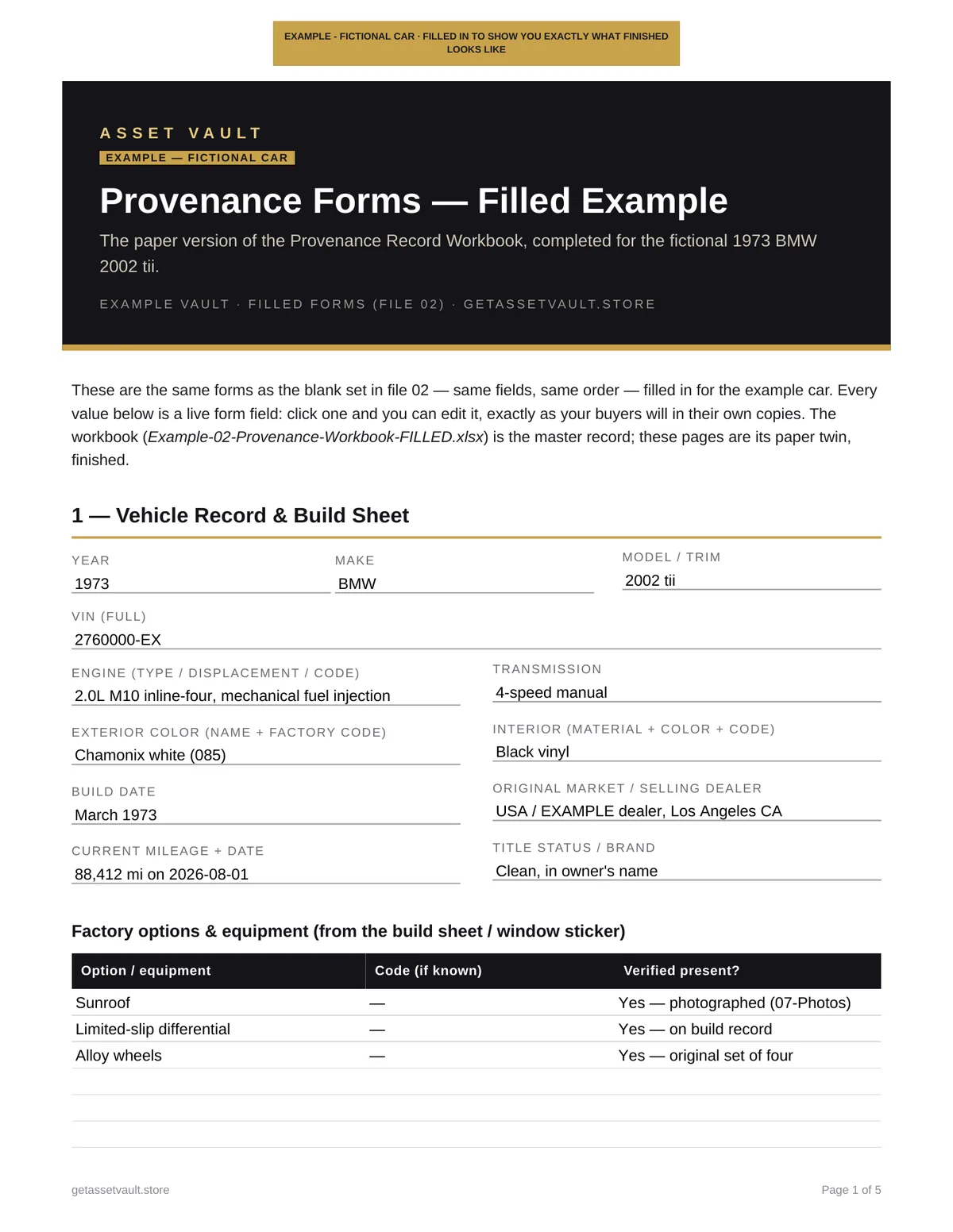
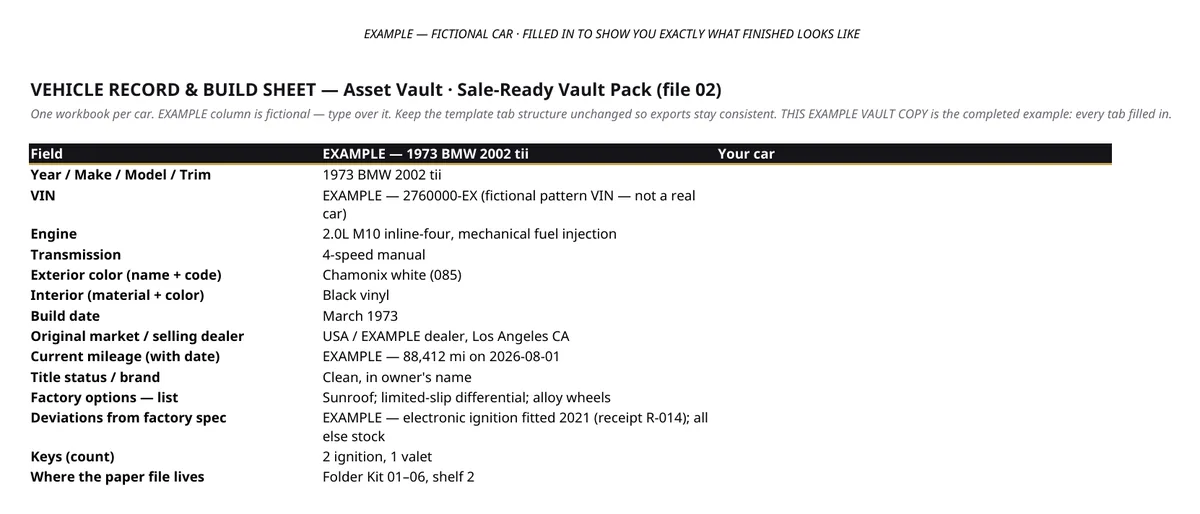
What gets checked: buyers verify that the VIN on the car, the VIN on the title and the numbers on the engine and gearbox tell the same story — and that the paint and trim codes either match the car in front of them or the difference is disclosed in writing. Insurers check identity before agreed value: the file has to prove the car insured is the car described. In the Example Vault, this section is a single filled form — year, VIN, engine, transmission, colors and options — that every later document references.
2. Ownership chain
- Title / registration history in your name and prior, as far back as it goes
- Each prior owner: name (or “unknown”), location, years held, mileage in/out
- Bills of sale through the chain where they exist
- Your acquisition record: seller, date, price, condition and mileage at purchase, your inspection notes
Where it lives today: mostly in people’s memories and old email threads. Prior owners move, shops close, and the story that “everyone knows” about a car evaporates one sale at a time — unless somebody writes it down while the witnesses are still reachable.
What gets checked: continuity. A chain with names, dates and mileages that line up reads as a cared-for car; a chain with an unexplained decade reads as a question the buyer prices into the bid. Gaps are acceptable — every long-lived car has them — but they must be labeled as gaps, not smoothed over. The Example Vault’s chain runs three owners deep, each with years held and mileage in and out, so the car’s life reads as one continuous account.
3. Service, repair & restoration history
- Chronological log: date, mileage, work performed, who did it (shop name or “owner”)
- Every major job as its own entry — engine, gearbox, suspension, brakes, cooling, electrical, paint & body
- Restoration documentation: scope, photos before/during/after, who performed it
- Modifications list — what changed from factory, when, and whether it’s reversible; keep removed original parts documented too
- DIY work logged with the same detail as shop work — this is the record no database will ever have
Where it lives today: in shop invoices (if the shop reported them anywhere at all), in your head, and nowhere else. Commercial history reports only contain what shops, dealers and insurers fed them — the independent specialist, the marque expert two states away, and your own Saturday engine-out service are invisible to them by design.
What gets checked: buyers look for recency and provenance on the big-ticket items — when the engine work was done, by whom, and whether the entry is a log line they can cross-reference against an invoice (that’s Section 4). Insurers look for evidence the car is maintained to the standard its agreed value assumes. The log is the spine of the whole file: one chronological record, in a workbook built for exactly this, rather than a pile of PDFs named by a scanner.
4. Receipts & parts provenance
- Invoices for every logged job, filed against the log entry
- Parts receipts with supplier, part numbers and cost — especially major components (engine internals, suspension, brake kits, wheels, interior)
- Shipping/import documentation for significant parts where relevant
- A running total of documented spend — buyers and insurers both read this number
Where it lives today: in a glovebox envelope, a shoebox, and three email accounts — which is to say, effectively nowhere, because a receipt that can’t be found during a sale doesn’t exist for the buyer.
What gets checked: receipts are what convert claims into facts. “Engine rebuilt in 2022” is a claim; the invoice with the shop’s name, the parts list and the total is a fact a bidder can price. Buyers sample-check the largest entries against the log; insurers read the documented-spend total as supporting evidence for value. In the Example Vault, 34 receipts reconcile to a documented spend of $14,410.35 — the same total in the log, the receipts index and the summary sheet, because a file that disagrees with itself invites exactly the suspicion it exists to remove.
5. Condition evidence
- Current inspection report where available; compression / leakdown results for performance and older engines
- Paint-meter readings panel by panel, where the marque market cares
- Known-flaws list with dated photos — rust, wear, leaks, non-working items — written before a buyer finds them
- Mileage evidence: odometer photos over time, inspection records, title mileage entries
Where it lives today: condition evidence usually doesn’t exist until a pre-purchase inspection creates it — at the worst possible moment, on the buyer’s terms, days before the sale.
What gets checked: buyers compare your stated condition against the car panel by panel; a flaws list they can verify item by item builds more trust than any superlative in the listing copy. Insurers want dated condition photos and inspection evidence behind an agreed value — proof of what the car was on the day the value was set. Dated, repeated evidence (odometer photos across years, meter readings across panels) is what separates a condition claim from a condition record.
6. Photo documentation
- The essential set: all exterior angles, panel gaps, underbody, engine bay, interior, trunk, VIN and data plates, odometer
- Process photos from every major job — the engine out, the metal work, the parts before install
- For a sale: the full auction set (100–200 photos plus cold-start and driving video) — see the auction listing preparation guide
Where it lives today: scattered across old phones and cloud accounts, unshot entirely for the angles that matter most — nobody photographs an underbody for fun, which is precisely why buyers ask for it.
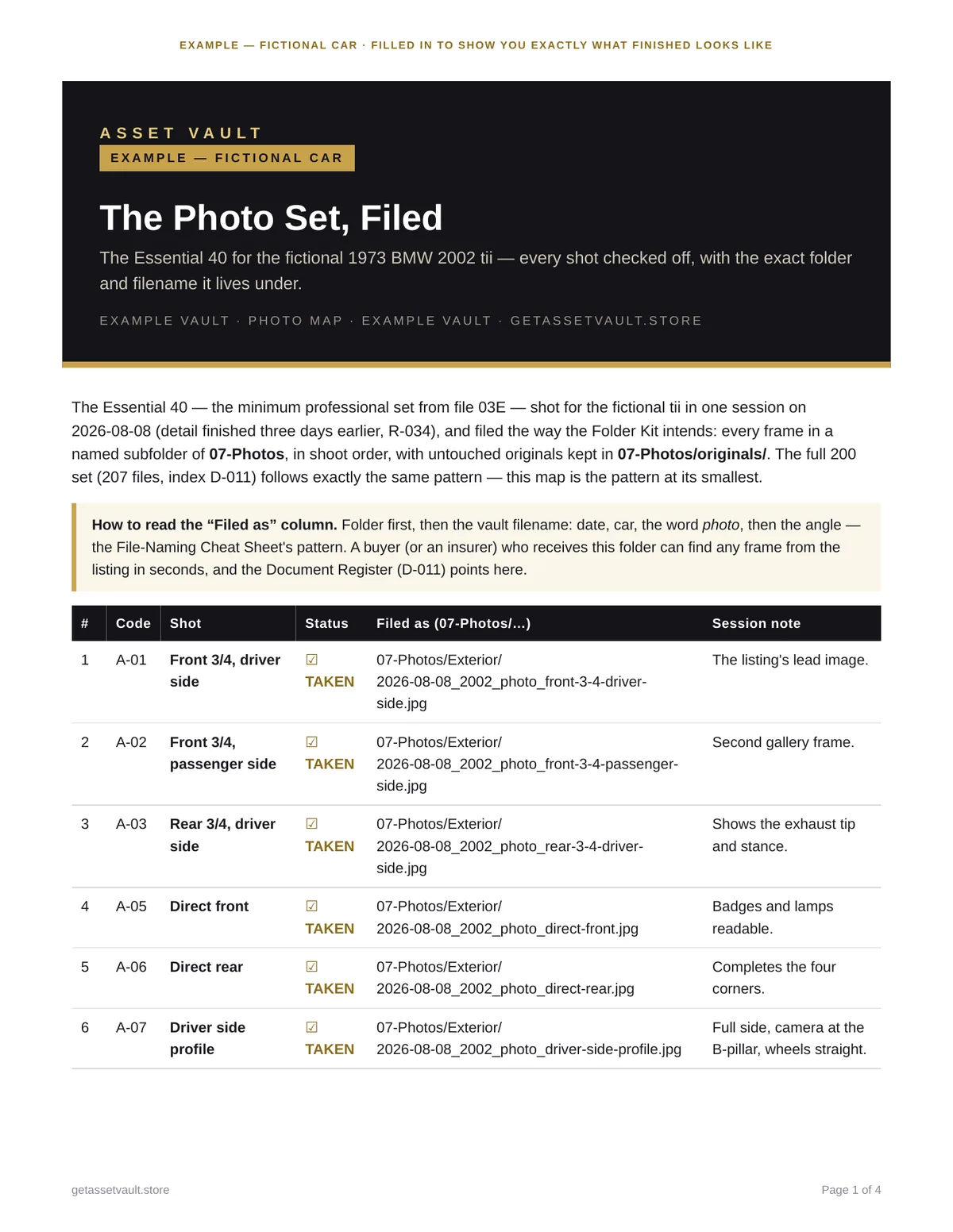
What gets checked: coverage and honesty. Auction buyers inspect a gallery the way they’d inspect the car: every panel, the gaps, the underside, the plates, and the flaws shot as carefully as the highlights. The working set has two depths — the 40 essential shots every file should hold from day one, and the full 200-shot auction set built for a sale. The Example Vault’s photo set map checks the essential 40 off one by one, each mapped to where the file lives.
7. Valuation evidence
- Comparable sales: same model/year/spec, with dates and venues
- Valuation-guide references for the model and condition grade
- Your documented spend and the car’s file summary — the argument for your number, in writing
Where it lives today: usually nowhere — most sellers price from asking prices and optimism, then negotiate from a number they can’t defend.
What gets checked: buyers and their advisors rebuild your price from the same comps, so a file that already contains them — real sales, dated, with venues — ends the argument before it starts. Insurers set agreed values from the same material: comps plus condition evidence plus documented spend. This section is where the other six become a number. More on turning it into a result in how to sell a collector car for more.
The file at a glance
The whole checklist on one screen. A section is complete when you can produce its evidence in under a minute:
| Part of the file | “Complete” means you can show | Done |
|---|---|---|
| 1. Identity & build data | VIN/title/engine numbers agreeing, build sheet or certificate, codes decoded | ☐ |
| 2. Ownership chain | Every owner named or honestly marked unknown, with years and mileages | ☐ |
| 3. Service history | One chronological log — shop, specialist and DIY work in a single record | ☐ |
| 4. Receipts & provenance | An invoice behind every major log entry, and a spend total that reconciles | ☐ |
| 5. Condition evidence | Dated inspection results, meter readings, and a written known-flaws list | ☐ |
| 6. Photo documentation | The essential 40 on file; the 200-shot auction set planned or shot | ☐ |
| 7. Valuation evidence | Dated comparable sales and guide values supporting your number | ☐ |
Files, apps, or a shoebox: an honest comparison
There are three places a record like this can live, and the differences matter more than the tools.
The shoebox
Free, and worth roughly that at sale time. Paper in a box is unsearchable, unshareable, and one house fire from gone — and even intact, it arrives at the sale as a pile the buyer has to interpret, which they do conservatively. Its one genuine virtue: originals matter, and the paper original of a build sheet or invoice should be kept. Keep the originals; don’t make them the system.
An app
Convenient to enter, pleasant to browse — and held on someone else’s server, under an account, behind a subscription that renews for as long as you own the car. Two honest limits: entries you log yourself never reach the official history report a buyer pulls, so the app’s record still has to be exported and handed over at sale time; and owners have lost vehicles and years of history to app updates, forced logouts and shutdowns. If the company folds, your file’s survival is their decision, not yours.
Files in your custody
The system this checklist describes: standard formats (fillable PDFs and spreadsheets) on your own computer or drive, organized so the whole file — or any single document — can be handed to a buyer, an auction house or an insurer in one pass. No account, no server, no subscription, nothing that can be shut down under you. The honest cost: custody means the backup routine is yours, and filling in real forms takes more discipline than tapping an app. For a record whose entire job is to outlive apps, companies and owners, we think that trade is the point.
This checklist, as fillable templates
The free checklist above is the map. The Sale-Ready Vault Pack is the territory: fillable record templates, the receipts and provenance logs, the 200-photo shot list, the valuation worksheet and the export builder that assembles all of it into a buyer-ready packet — from $99.
Keeping it current (the 10-minute rule)
A record file dies by backlog. The rule that keeps it alive: every job gets its log entry, receipts and photos filed within a day of the work, while the details are free. Ten minutes per job across years of ownership builds the file that takes sellers 10–20+ hours to reconstruct under sale pressure — the difference between a record and a reconstruction is exactly what buyers pay for. The full strategy is in how to sell a collector car for more.
Frequently asked questions
My car’s history has gaps. Is the file still worth building?
Yes — a file that documents what exists and honestly labels what’s missing beats silence at every price point, because buyers discount the unknown far harder than the disclosed. Start the chain at your acquisition, recover what you can (prior owners, shops and marque registries can often replace lost records), and let the file be complete from today forward.
Is a history report (CARFAX and similar) enough on its own?
No. Those databases hold only what dealers, reporting shops, insurers and agencies fed them. DIY work, independent shops that don’t report, and most older-car history never appear — which is most of what makes a collector car valuable. The owner-side file is the other half of the record, and it’s the half you control.
Should I keep paper originals, or scan everything and move on?
Both. Scan everything into the file so it’s searchable, backed up and hand-over-able; keep the paper originals of the documents with intrinsic weight — build sheets, window stickers, early invoices — stored safely. The file should note where each original lives.
How long does it take to build the file for a car I’ve owned for years?
The first pass — identity, your ownership record, whatever history and receipts you can gather, the essential photos — is an afternoon to a weekend for most cars. After that, the 10-minute rule keeps it current. What you can’t do is compress it into the week before a listing without it showing; that gap between a record and a reconstruction is the whole argument of this checklist.
Sources: Vehicle Remarketing Association on missing service histories, as reported by Motor Trade News. The Example Vault is a worked example completed for a fictional 1973 BMW 2002 tii; it ships with every tier of the pack so buyers can inspect the finished system before building their own.
Related guides
- How to sell a collector car for more — the documentation playbook: turning this file into price, venue choice and listing copy.
- Auction listing preparation — the photo set, records packet and timeline a competitive online auction listing requires.
- How to sell on Bring a Trailer — the documentation & photo playbook for BaT: selection, the packet, and auction week.